



Your Cotswold Walls Are Trying to Tell You Something
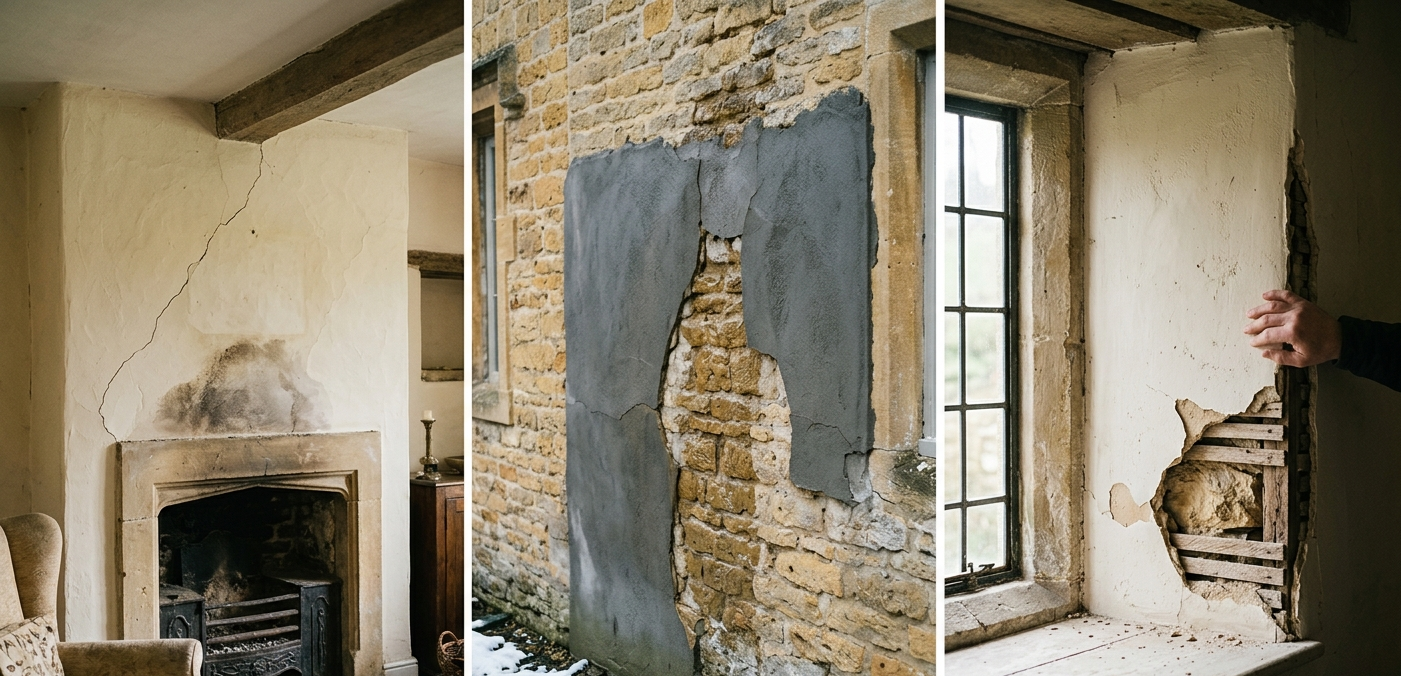
That hairline crack above the fireplace. The damp patch that reappears every winter. The plaster that sounds hollow when you tap it. These are not cosmetic inconveniences. They are symptoms of deeper issues that, left untreated, can cause serious structural damage to your Cotswold home.
Cotswold properties face a unique set of challenges. The local oolitic limestone is porous and naturally absorbs moisture. Walls were originally built with lime mortar and finished with lime plaster, creating a system that breathes and manages moisture effectively. When that system is disrupted, often by well meaning renovations using modern materials, problems emerge.
This guide covers the most common plastering problems found in Cotswold homes, explains why they happen, and walks you through the correct repair methods. Some fixes are straightforward. Others require professional intervention. Knowing the difference can save you thousands.
Problem 1: Cement Render Trapping Moisture in Stone Walls
This is the single most destructive plastering problem in the Cotswolds, and it is entirely man made.
What happens: At some point, a previous owner or contractor applied cement based render or plaster over the original Cotswold stone. Cement is rigid and impermeable. It seals the wall, trapping moisture that would normally escape through the porous limestone and lime plaster.
Why it matters: Trapped moisture travels inward, causing damp patches, black mould, and a musty smell inside the property. In winter, moisture trapped within the stone can freeze, expanding and fracturing the limestone from within. Over years, this cycle of freeze and thaw literally destroys the structural stone.
The fix: Remove the cement render completely to expose the original stone. Allow the walls to dry out, which may take several weeks depending on the extent of moisture saturation. Then apply a breathable lime render system that works with the building rather than against it.
Cost: Stripping cement render and replacing with lime typically costs £60 to £120 per square metre, but the long term savings in prevented structural damage make this one of the smartest investments a Cotswold homeowner can make.
Problem 2: Cracking Along Walls and Ceilings
Cracks in plaster are practically universal in older properties. But not all cracks are equal.
Hairline cracks (under 1mm): These are common and usually harmless. They occur as plaster dries and cures, or as the building naturally moves with seasonal temperature changes. Lime plaster, with its slight flexibility, develops fewer of these than rigid gypsum.
Structural cracks (over 3mm, diagonal, or stepped): These suggest movement in the building’s structure. Subsidence, settlement, or lateral movement of load bearing walls can all produce cracks that follow the mortar joints in a stepped pattern. These require structural assessment before any plaster repair.
Map cracking (a network of fine cracks across a surface): This pattern typically indicates that the plaster dried too quickly, was applied too thickly in a single coat, or that the wrong mix ratio was used. It is common in cement based renders but can also appear in lime plaster that was not kept damp during the curing period.
The fix: For hairline cracks, a lime based filler and redecoration is usually sufficient. For map cracking caused by material failure, the affected area needs hacking off and replacing with correctly specified and applied plaster. Structural cracks must be assessed by a structural engineer before any cosmetic repair.
For more about identifying and resolving plaster cracks, see our guide on common plastering problems.
Problem 3: Blown and Hollow Sounding Plaster
Tap your wall with your knuckle. If it sounds hollow or drum like, the plaster has detached from the substrate. Plasterers call this “blown” plaster.
What causes it: In Cotswold homes, blown plaster usually results from one of three things. First, moisture has weakened the bond between the plaster and the stone. Second, the original lime plaster has carbonated fully and become brittle over centuries of use. Third, someone applied a modern plaster over an old lime surface without proper preparation, and the two materials have failed to bond.
Why ignoring it is risky: Blown plaster is structurally unsound. On ceilings, it poses a genuine safety risk, as large sections can fall without warning. On walls, it will continue to detach and eventually collapse.
The fix: Small areas of blown plaster can sometimes be stabilised by injecting a lime based consolidant behind the surface. Larger areas need removing and replastering with compatible materials. If the plaster is on a lath and plaster ceiling, check the condition of the laths before deciding on the repair method. Rotten or broken laths need replacing before any new plaster can be applied.
For guidance on ceiling repairs, see our article on repairing lath and plaster ceilings.
Problem 4: Rising Damp and Salt Deposits
Rising damp is a genuine issue in many Cotswold cottages, particularly those built without a damp proof course. Moisture travels upward from the ground through the porous stone walls, carrying dissolved mineral salts with it.
What you see: A tide line of damp staining on internal walls, typically up to one metre above floor level. White, fluffy salt deposits (efflorescence) on the plaster surface. Crumbling, soft plaster below the tide line. Paint that bubbles, peels, or flakes in the same area year after year.
What you should not do: Inject a chemical damp proof course and then plaster over with gypsum. This common “solution” often makes things worse in stone buildings. The injected chemicals may not penetrate irregular stone adequately, and gypsum plaster over a damp wall simply hides the problem while the stone continues to deteriorate behind it.
The correct approach: Accept that some ground moisture in a Cotswold stone cottage is normal. Manage it with a breathable lime plaster system. Apply a sacrificial lime render to the lower walls that allows the moisture to evaporate from the surface. This “sacrificial” layer can be renewed every few decades, protecting the structural stone behind it.
Supporting the fix: Improve external drainage, ensure ground levels are below internal floor levels, and maintain good ventilation at skirting level. These measures reduce moisture load and allow the lime plaster system to work effectively.
Problem 5: Mould and Black Spots
Mould on plaster is primarily a ventilation and condensation issue, but the wrong plaster material can make it significantly worse.
The connection to plaster type: Modern gypsum plaster and vinyl paint create an impermeable surface. In a Cotswold stone property that produces moisture through its walls, this sealed surface collects condensation. Black mould thrives on this damp surface, particularly behind furniture, in corners, and around window reveals where air circulation is poorest.
Lime plaster’s advantage: Lime is naturally alkaline with a pH around 12. This high alkalinity actively inhibits mould and fungal growth. Combined with its breathability, lime plaster creates an environment where condensation is far less likely to form. When it does, the moisture evaporates through the plaster rather than sitting on the surface.
The fix: If mould is growing on modern plaster in a Cotswold home, treat the immediate problem with a fungicidal wash. Then address the root cause. Improve ventilation, ensure any trickle vents in windows are open, and consider replacing impermeable gypsum finishes with breathable lime plaster and mineral paint.
Learn more about eco friendly plastering solutions that naturally resist damp and mould.
Problem 6: Previous Patch Repairs That Do Not Match
Cotswold homes accumulate a patchwork of repairs over the decades. Cement patches over lime walls. Gypsum repairs on lime ceilings. Different mix ratios creating visible colour and texture differences across a single wall.
Why this matters beyond aesthetics: Mismatched materials create stress points where different plasters meet. Hard cement next to soft lime creates a boundary where cracks inevitably form. Different thermal expansion rates between gypsum and lime cause edges to crack and separate. Water migrates to the interface between incompatible materials and accelerates decay.
The fix: For a lasting repair, the incompatible patches must be removed and the entire area replastered with a consistent, appropriate material. On a period Cotswold property, that means lime plaster specified to match the original.
Problem 7: External Render Cracking and Detaching
External lime render on Cotswold homes takes a beating from the weather. Rain, frost, wind, and UV exposure all stress the surface. Over time, even correctly applied lime render will need maintenance and eventual renewal.
Common symptoms: Fine cracks that allow rain to penetrate behind the render. Sections that sound hollow when tapped. Visible detachment at edges, corners, and around window and door openings. Green algae growth in sheltered areas that retain moisture.
The fix: Minor cracks can be treated with a lime wash or thin lime slurry coat that fills the cracks and refreshes the surface. Hollow sections need cutting out and replacing with a matching lime render, keyed properly into the surrounding material. Severely deteriorated render should be stripped entirely and replaced with a new three coat lime system.
Prevention: Regular lime washing (every three to five years) extends the life of external render by filling micro cracks and refreshing the protective surface layer.
EEAT: What 15 Years of Cotswold Plastering Has Taught Us
Working across the Cotswolds for over 15 years, Heritage Plastering has seen every one of these problems repeatedly. The common thread is almost always the same: at some point, someone used the wrong material.
Cement render on Cotswold stone is the number one cause of the problems we repair. It looks fine when first applied but begins causing damage within years. By the time homeowners notice the damp patches inside, the external stone has often suffered frost damage that would have been entirely preventable.
We have stripped hundreds of square metres of cement render from Cotswold stone cottages and replaced it with breathable lime systems. Every time, the improvement is dramatic. Walls dry out. Damp patches disappear. Indoor air quality improves. And the building starts doing what it was designed to do: breathe.
Our team adapts the lime mix depending on the specific stone, the wall’s exposure, and the local microclimate. A north facing wall in a Gloucestershire valley needs a different approach to a sheltered south facing elevation. This is knowledge that comes from experience, not from a textbook.
Frequently Asked Questions
Can I repair Cotswold stone wall plaster myself? Minor cosmetic repairs with lime filler are manageable as a DIY task. However, any repair involving substrate preparation, damp treatment, or multi coat lime systems should be left to experienced professionals. Incorrect DIY repairs often make problems worse.
How do I tell if my plaster is lime or gypsum? Lime plaster is slightly softer, has a granular texture, and feels cool to the touch. Gypsum is smoother, harder, and often brighter white. Drop a small piece in vinegar: lime plaster will fizz as the acid reacts with the calcium carbonate.
Is it worth replastering a whole room or just patching the problem areas? If the existing plaster is broadly sound and the same material throughout, patching is perfectly acceptable. If you have a patchwork of incompatible materials, full replastering produces a better and more durable result.
How long do lime plaster repairs last? Correctly applied lime plaster on a suitable substrate can last 100 years or more. Many Cotswold properties still have original lime plaster from the 18th century that remains in good condition.
Will replastering with lime solve my damp problems? Lime plaster manages moisture rather than blocking it. It will not fix a leaking roof or broken gutter. But when you address the source of excessive moisture, lime plaster allows residual dampness to evaporate safely, eliminating damp patches and mould that impermeable modern finishes often trap.
Protect Your Cotswold Home with the Right Repair
Every plastering problem in a Cotswold home has a solution. The key is choosing the right one, not the quickest or cheapest. Lime plaster has protected Cotswold stone buildings for centuries because it works in harmony with the porous limestone. Modern materials have their place, but that place is not on the walls of a 200 year old cottage.
If your Cotswold home is showing any of the problems described in this guide, start by getting a professional assessment. Understanding the cause comes before choosing the cure. And a correct diagnosis from an experienced plasterer can save you from expensive mistakes.
Contact Heritage Plastering today for expert advice on your Cotswold property’s plastering needs.