



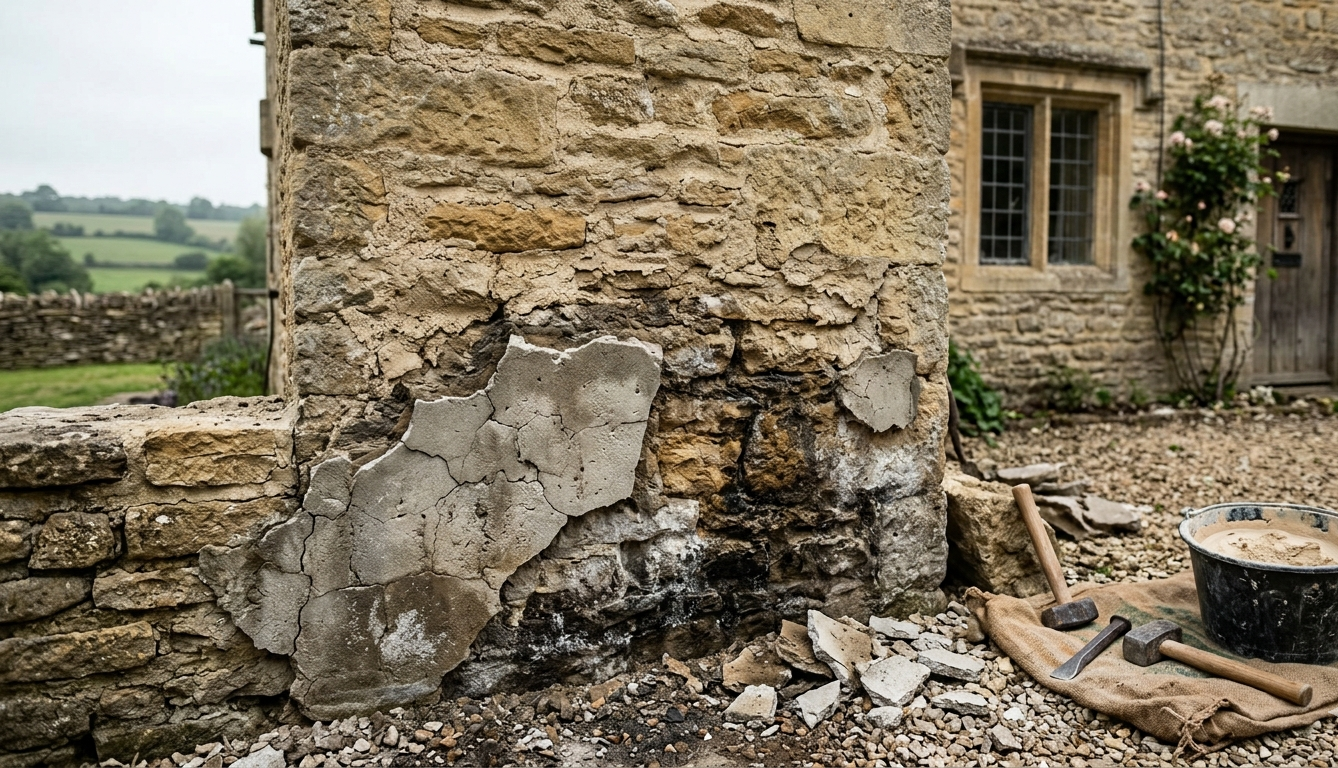
You’ve noticed patches of discolouration, a cold, clammy feel to the wall, maybe paint peeling or plaster bubbling near the base of an old stone or brick room. The instinct is to blame the weather, or rising damp, or aging brickwork. But in many period properties across Cheltenham and the Cotswolds, builders applied cement render decades ago as a solution, and it has since become the real culprit.
Understanding why cement render causes damp problems and how lime plaster corrects them could save you thousands in ongoing repairs.
How Cement Render Causes Damp Walls
Old stone, rubble-filled walls, and lime-bonded brick were never designed to be waterproof. They were designed to be breathable. Moisture enters these walls through rain, rising groundwater, and condensation. The original lime-based renders and plasters let that moisture travel through the wall and evaporate harmlessly at the surface.
Portland cement render works differently. It forms a rigid, dense, largely impermeable coat. Water still gets into the wall through cracks in the render itself, through the masonry above, or from the ground, but now it cannot get back out easily. The wall becomes saturated behind the hard cement skin.
The problems with Portland cement on period walls are well-documented among conservation specialists. Salt crystallisation, spalling stonework, and internal dampness are all predictable consequences of sealing a breathing wall with an impermeable material.
Why Old Buildings Need Breathable Materials
When cement render replaces that lime system, the moisture that previously evaporated through the render has nowhere to go. It concentrates at the junction between old masonry and new render, driving salts to the surface, damaging the bond, and creating the damp conditions that cause mould, timber decay, and plaster failure.
In Cheltenham’s Georgian and Victorian terraces, and in the older stone farmhouses across the Cotswolds, this pattern appears constantly. The cement render looks solid and weather-tight right up until the wall behind it starts to deteriorate badly.
What Lime Plaster Actually Does?
Lime plaster is vapour-permeable. It allows water vapour to pass through the render and evaporate at the surface, maintaining the moisture balance within the wall. This is what conservation specialists call breathability, and it is not a minor detail it is the fundamental reason lime plaster is specified for heritage buildings.
Beyond breathability, lime is also flexible. Old buildings move. Seasonal temperature changes, settlement, and timber shrinkage all cause slight movement in the structure. Cement render cracks under this movement because it is rigid. Lime plaster accommodates minor movement, which is why you see fewer map-crack failures in properly maintained lime systems.
The comparison between lime render and cement render explains the material differences in practical terms and helps homeowners understand why specification matters before any external rendering work begins.
Removing Cement Render: What to Expect
Taking off cement render from an old stone or brick wall is skilled work. The cement bonds hard to the surface, and removing it without damaging the masonry behind requires care. Mechanical tools can chip and fracture stone; hand tools take longer but preserve the substrate.
Once the cement is off, the wall usually needs time to dry out before new lime can be applied. Depending on how long the cement was in place and how saturated the wall has become, this drying period can take weeks or months. Applying lime plaster to a wet wall risks failure, so the patience required here is not optional.
After the wall is dry, the correct lime specification is chosen based on the masonry type, exposure level, and the finish required. This is not a one-product-fits-all situation. A sheltered internal wall needs a different approach to an exposed north-facing gable.
The Plastering Process: Coat by Coat
A lime render system is typically applied in two or three coats. Each coat is applied, scratched to create a key for the next, and then left to carbonate before proceeding. Rushing this process causes the coats to move and crack. Done properly, the lime plastering process produces a finish that is durable, breathable, and appropriate for the building it covers.
Can You Put Lime Render Directly Over Cement?
This question comes up regularly, and the short answer is: you should not. Lime render applied over intact cement render creates a system that still cannot breathe properly, because the cement beneath still blocks moisture movement. The only reliable fix is removing the cement and starting with a clean, compatible substrate.
Signs That Cement Render Is Causing Your Damp
Several patterns point clearly to cement render as the source of moisture problems:
Damp patches are appearing on internal walls directly behind cemented external elevations. Salting and white mineral deposits (efflorescence) on internal plaster surfaces. Blown or hollow lime plaster on interior walls where cement render exists externally. Paint repeatedly peels in the same areas despite redecoration. A smell of mould or mustiness in rooms with solid stone or brick walls.
If your property shows these signs and has cement render on its external walls, there is a high probability the two are connected.
The Long-Term Cost of Getting It Wrong
Repointing or re-rendering with cement to fix apparent damp is a very common mistake. It seems logical to seal the wall, stop water from getting in. But on a breathable old building, this approach accelerates internal damage. Structural timbers embedded in saturated walls begin to decay. Plaster falls. Stonework spalls.
The repair bills grow, and homeowners often spend years treating symptoms, damp-proofing, repainting, and replastering without ever addressing the root cause. Switching to lime plaster and lime render, done properly, breaks that cycle.
Advantages of lime render over cement systems go beyond breathability alone, covering durability, flexibility, and the long-term protection lime provides to the masonry behind it.
FAQ
How can I tell if my old property has cement render rather than lime?
Cement render is typically hard, grey, and does not crumble when scratched with a key. Lime render is softer, slightly powdery, and often a warmer cream or off-white colour. If in doubt, a specialist can test a small sample.
Is all dampness in old houses caused by cement render?
No. Dampness in period properties can come from roof defects, failed gutters, rising damp, condensation, or plumbing leaks. Cement render is a very common cause, but not the only one. A thorough survey identifies the actual source before any work begins.
How long does it take for damp walls to dry out after the cement render is removed?
It varies depending on how long the cement was in place, the type of masonry, and weather conditions. In some cases, walls dry within a few weeks. Heavily saturated stone walls can take several months. A moisture meter reading confirms when the wall is ready for new lime plaster.
Will lime render protect my external walls from driving rain?
Yes. A properly specified and applied lime render provides effective weather protection while still allowing the wall to breathe.
Do I need planning permission to remove cement render from a listed building?
Removing cement render from a listed building falls under works affecting its character, which may require Listed Building Consent. Always check with your local planning authority before beginning work on a listed or locally listed structure.
Closing Thoughts
If your property was built before the 1920s and your walls are damp, inspect the cement render carefully before investing in any other damp remedy. The fix is not always quick or cheap but removing incompatible cement and replacing it with the right lime system is a lasting solution rather than a temporary patch.
Heritage Plastering specialises in exactly this kind of diagnostic and remediation work across Cheltenham, Gloucestershire, and the Cotswolds. Get in touch for a site assessment and find out what your walls actually need.