



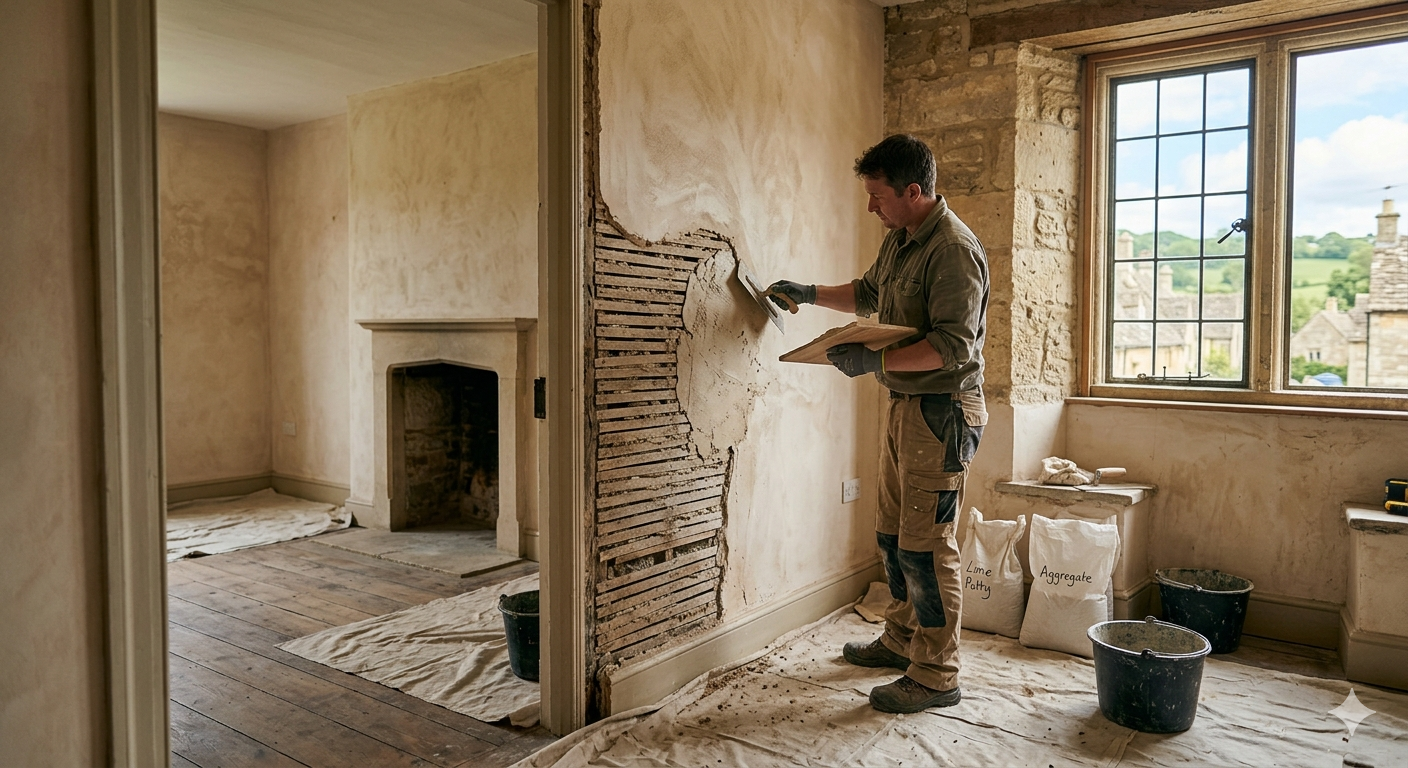
Owning a Grade II listed property carries real responsibility. Every repair, every material choice, and every contractor you invite onto the site contributes to either the preservation or the erosion of a building’s historic character. When it comes to plaster repair, getting this right is not simply about aesthetics it’s about meeting legal obligations, avoiding enforcement action, and protecting the long-term structural health of a building that belongs, in a meaningful sense, to our shared history.
This checklist is designed for homeowners, architects, and building managers working on Grade II listed properties across Cheltenham, Gloucestershire, and the Cotswolds.
Why Listed Building Plaster Repair Is Different
Most plasterers use gypsum-based products because they dry quickly, are widely available, and feel familiar to work with. However, when they apply gypsum plaster to an original lime substrate in a Grade II listed building, they create a physically incompatible barrier that can damage the wall beneath it.
Lime plaster allows walls to breathe, flex, and absorb wear by design. In contrast, gypsum plaster creates a rigid, moisture-trapping surface and bonds differently to the substrate. When plasterers apply gypsum over old lime, they trap moisture at the junction, cause delamination, force salts into the masonry, and eventually damage the historic fabric that the listing is meant to protect.
Why lime plaster is essential for listed and heritage buildings explains the technical case clearly but the compliance case is equally important. Conservation officers across Gloucestershire will scrutinise materials used in listed building repairs, and the wrong choice can result in enforcement notices and costly remediation.
The Conservation Compliance Checklist
-
Confirm Whether Listed Building Consent Is Required
Not every internal repair to a listed property requires formal consent, but the boundary is not always obvious. As a general principle, any work that affects the character of a listed building requires Listed Building Consent. Internal plaster to a principal room, decorative cornicing, or original ceiling finishes would typically fall under this threshold.
Before you begin any work, contact your local planning authority and get written confirmation about whether you need consent. Do not assume internal work is exempt. Conservation officers can decide whether consent applies, and carrying out work without required approval is a criminal offence.
-
Establish the Existing Plaster Specification
Before any repair begins, identify what the existing plaster is made of. Is it a traditional lime putty system? A hydraulic lime mix? Is there any evidence of previous cement-based repairs that need removing first?
A specialist surveyor or conservation-experienced plasterer can assess the existing material by visual inspection, testing, and scratch testing. This step determines the specification for repair and skipping it leads to guesswork that fails the building and the compliance test.
Lime plaster in historic buildings gives a useful grounding in how original materials behave and why matching them matters for both performance and regulatory approval.
-
Choose a Contractor with Demonstrable Heritage Experience
In a Grade II listed building, this is not the moment to use a generalist plasterer. Conservation-quality lime work requires specific training, experience with traditional substrates, and knowledge of current heritage standards including those set by Historic England and the Society for the Protection of Ancient Buildings.
Ask any contractor you’re considering for examples of similar listed building work they’ve completed. Ask whether they’ve worked alongside conservation officers or architects with heritage specialisms. Specifically ask about their lime plaster experience the mixes they use, the coat systems they apply, and how they handle adjacent original material during repairs.
-
Use Only Compatible, Reversible Materials
The principle of reversibility is central to conservation work. Any repair made today should be removable or replaceable by future conservators without further damage to the original fabric. This rules out cement, modern bonding agents, and most gypsum products.
Appropriate materials for Grade II listed plaster repair include:
Natural hydraulic lime (NHL) mixes for moderately exposed or damp-prone areas. Lime putty with sharp sand for interior finish coats requiring a traditional soft texture. Coarse stuff mixes lime putty with aggregate for scratch and floating coats. Haired lime plaster where original hair-reinforced coats are present.
Each choice depends on the substrate, condition, and position of the repair. A blanket specification is not appropriate for listed building work.
-
Document Everything Before and During Work
Conservation-quality repair generates records. Photograph the area before work begins. Note the condition of the existing plaster, any historic decorative features, and any evidence of previous repairs. During the work, photograph each coat before the next is applied.
This documentation provides evidence of compliance for the planning authority, gives future owners and conservators a record of the work completed, and protects the contractor from unfounded claims about damage to the original fabric.
-
Address Any Underlying Problems First
Plaster does not blow or crack without reason. In a listed building, the cause must be found and fixed before any repair is made to the plaster surface. Common causes include roof leaks, failed guttering, rising damp, condensation, and inappropriate previous repairs using cement or gypsum.
Repairing the plaster without addressing the underlying problem simply means the problem returns, often worse. On a listed property, repeated failure of repair plaster will attract the conservation officer’s attention. Get the building dry and stable before any new lime goes on.
Heritage building repairs in Gloucestershire cover the broader context of what conservation repair involves and how structural and material problems interact.
-
Allow Adequate Curing Time Between Coats
Lime plaster is not fast. Each coat requires time to carbonate and harden before the next is applied. Rushing this process causes the coats to move, crack, and delaminate, producing exactly the kind of visible failure that attracts scrutiny on a listed property.
In cool or damp conditions, curing takes longer. In winter, frost can prevent carbonation entirely, so contractors protect lime work to stop fresh plaster from failing. A good contractor will plan the programme around weather conditions and build in proper curing intervals as a non-negotiable part of the schedule.
-
Specify the Correct Finish
The finish coat on a listed property repair should match the character of the surrounding original plaster. This might be a smooth float finish, a wood-float texture, or a sand-faced open texture, depending on the age and regional tradition of the building.
In many Georgian properties in Cheltenham, for example, the original finish is a fine lime putty skim producing a smooth, slightly warm surface very different from the hard, bright finish of modern gypsum. Matching this correctly is a skill that takes practice and knowledge of period techniques.
Who Should Carry Out This Work?
A specialist with direct experience in conservation plaster repair should carry out work on a Grade II listed building. Heritage Plastering brings over 15 years of experience working on listed and heritage buildings across Cheltenham, Gloucestershire, and the Cotswolds. The team holds CSCS certification and works alongside architects and conservation officers to ensure every repair meets heritage standards.
If you’re at the point of planning repairs to a listed property, choosing the right plasterer in Cheltenham walks through the key questions to ask any contractor before a decision is made.
FAQ
Do I always need Listed Building Consent for plaster repairs?
Not always, but more often than people expect. Works that affect the character of the listed building including removal of original plaster or application of incompatible materials typically require consent. Always confirm with your local planning authority in advance.
What happens if I use the wrong materials on a listed building?
Using incompatible materials such as gypsum plaster or cement render on a listed building can result in an enforcement notice from the local planning authority, requiring you to restore the building to its original condition at your own expense. In serious cases, it can lead to prosecution.
How do I find a plasterer with genuine listed building experience?
Ask for specific examples of past listed building projects. Ask whether they’ve worked under conservation officer oversight. Check whether they understand lime specifications, such as the difference between lime putty and NHL mixes, and whether they can advise on reversible repair approaches.
Can decorative plasterwork, such as cornices, be repaired rather than replaced?
Yes, in most cases. Skilled conservation plasterers can repair missing or damaged sections of cornice, ceiling rose, and decorative moulding using lime-based casting mixes matched to the original profile. Replacement is a last resort.
How long does lime plaster take to dry in a listed building context?
Typical three-coat lime plaster systems take several weeks to fully carbonate. The exact timeline depends on coat thickness, ambient temperature, humidity, and ventilation. Conservation specifications should always allow adequate curing time; rushing produces visible failures.
Closing Thoughts
Grade II listed plaster repair is one of those tasks where the cost of getting it wrong far exceeds the cost of getting it right. Enforcement action, remediation of incorrect repairs, and long-term building damage are all avoidable, but only if the right materials, the right contractor, and the right process are in place from the start.
Start with this checklist, then contact Heritage Plastering for a site assessment and a tailored approach that matches your property’s specific conservation requirements.