



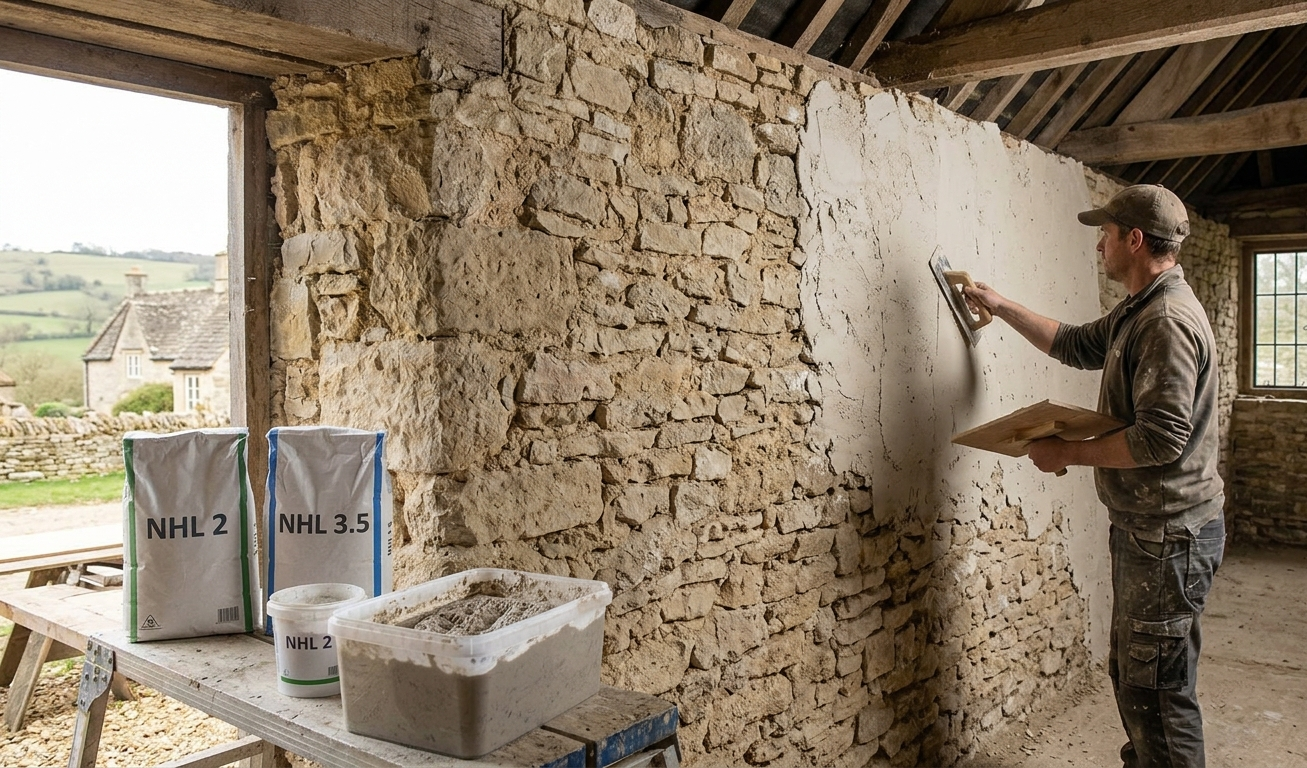
When you start looking seriously at lime plastering for an older property in the Cotswolds, you quickly encounter a range of product specifications that aren’t always easy to interpret.
This guide explains what separates these two specifications, where each one is most appropriate, and what local conditions across Gloucestershire and the Cotswolds make that choice particularly important.
What Does NHL Mean?
NHL stands for Natural Hydraulic Lime. The number that follows 2, 3.5, or 5 refers to the minimum compressive strength of the set lime in megapascals (MPa) after 28 days. The higher the number, the stronger and faster the lime sets.
Unlike lime putty, which sets purely through carbonation as it absorbs CO₂ from the air, hydraulic lime also sets chemically when they come into contact with water. This dual-setting behaviour gives contractors more predictable performance in conditions where pure putty lime may struggle.
In period properties across Cheltenham and the Cotswolds, builders and conservators widely use NHL lime both externally and internally, especially where damp, exposure, or structural movement requires careful management.
NHL 2: The Soft, Breathable Option
NHL 2 is the weakest of the three main hydraulic lime grades. It sets relatively slowly, remains soft and flexible once cured, and produces a highly breathable finish. Its compressive strength sits at a minimum of 2 MPa, which sounds modest but is perfectly adequate for most internal plastering applications and sheltered external work.
The softness of NHL 2 is a feature, not a flaw. Softer plasters are more compatible with soft, porous substrates old limestone ashlar, hand-made brick, rammed earth, or cob because they do not create a harder skin that could trap moisture or stress the background as it moves.
For interior walls in traditional Cotswold stone buildings, NHL 2 is often the most appropriate backing coat specification. It allows the wall to continue breathing, remains repairable without aggressive mechanical intervention, and ages in a way that suits the character of the building.
Understanding the advantages of lime render more broadly helps clarify why matching the binder strength to the substrate matters so much in practice.
NHL 3.5: The Versatile Workhorse
Contractors in UK heritage work most commonly specify NHL 3.5 hydraulic lime. NHL 3.5 sets more robustly than NHL 2 and reaches a minimum strength of 3.5 MPa. Contractors use NHL 3.5 in moderately exposed elevations, damp areas, and variable substrates.
For Cotswolds properties, NHL 3.5 suits rubble stone walls, exposed elevations, and seasonal weather changes. NHL 3.5 provides a balance of strength and breathability for rural stone buildings.
Contractors achieve workable finishes while NHL 3.5 handles movement and exposure in these structures. Across Gloucestershire, builders use NHL 3.5 in three-coat systems for barn conversions and farmhouses. They apply NHL 3.5 in backing coats and finish with softer NHL 3.5 or lime putty mixes for surface character.
The lime plastering process walks through how these coat-by-coat systems work in practice, which is useful context for understanding why the specification of each individual coat matters.
NHL 3.5 vs NHL 2: The Key Differences at a Glance
The choice between them comes down to five practical considerations.
Substrate hardness. Soft, friable, or porous backgrounds need a softer, weaker binder. Harder or more stable substrates can accept the slightly stronger NHL 3.5. Using a mix that is harder than the background creates the risk of the plaster causing damage to the masonry.
Exposure level. External elevations facing west or north in the Cotswolds, catching prevailing wet weather, generally benefit from the slightly greater durability of NHL 3.5. Sheltered internal walls or south-facing elevations with good overhangs work well with NHL 2.
Damp conditions. Where walls are moderately damp or there is a history of moisture ingress, NHL 3.5’s faster hydraulic set helps it establish before prolonged wet conditions interfere. NHL 2 in persistently damp conditions can be slow to carbonate and more vulnerable during the early curing phase.
Conservation requirements. Some listed building conservation officers or heritage consultants specify NHL 2 for internal historic work because of its softness and compatibility with original materials. If working to a formal specification, always follow what’s stipulated rather than substituting.
Setting time. NHL 2 gives slightly more working time before the initial set. In hot weather or on large surfaces where extended workability matters, this can be an advantage. NHL 3.5 sets a little faster, which in cold or damp conditions helps it establish more reliably.
What About Lime Putty Instead?
Some conservation purists prefer lime putty over NHL limes for internal work, particularly in very old and delicate buildings. Lime putty is non-hydraulic, extremely soft, and sets only through carbonation. It needs warmth, ventilation, and time, but produces an exceptionally flexible, compatible finish for the most sensitive substrates.
Lime putty is less forgiving of poor conditions and typically slower to work with than NHL systems, so it’s often reserved for high-value conservation projects where authenticity of material is the primary concern rather than programme speed.
The comparison between lime plaster and gypsum plaster puts the full range of lime options in a broader context, helpful if you’re at the stage of deciding whether lime is the right family of materials for your project at all.
Real Examples from the Cotswolds
In a barn conversion project in the Cotswolds, contractors deliver similar results to those Heritage Plastering has completed across Gloucestershire, where they apply an NHL 3.5 three-coat system to sawn laths over 400 square metres of wall as a standard and proven specification. The strength of NHL 3.5 handles the variable timber background and seasonal movement well.
For a traditional stone farmhouse with single-skin rubble walls, a softer approach using NHL 2 or even lime putty for internal coats respects the fragility of the substrate and ensures the plaster can continue to move moisture through the wall without failure.
Contractors protect an exposed chimney stack or gable end on a north-facing elevation—where driving rain and frost are real concerns, by using NHL 3.5 and applying a dense, closed sponge finish that resists water penetration while still allowing the wall to breathe.
Getting the specification right requires understanding the building, not just the products. That’s why finding a lime plastering specialist in Gloucestershire with local knowledge and hands-on experience in Cotswolds property types is so important.
Mixing and Application Considerations
Contractors mix NHL 2 and NHL 3.5 with a sharp, well-graded sand at ratios that suit the coat being applied, and they typically mix backing coats at 1 part lime to 2.5 or 3 parts sand. Finish coats use finer aggregates and may reduce the sand ratio slightly for a smoother application.
Contractors add enough water to achieve workable consistency without making the mix wet or sloppy. They mix lime plaster stiffer than expected, especially for external work, where firmness helps it grip during initial set.
Contractors prioritise curing for both grades to ensure proper strength and durability. In hot, dry, or windy conditions, contractors keep new lime plaster damp to prevent rapid surface drying and cracking.
They gently mist fresh plaster during the first days to encourage carbonation instead of surface skinning.
Making the Right Choice for Your Property
If you plan a lime plastering project on a Cotswolds property, start with a proper building assessment. Assess substrate type, exposure, moisture levels, conservation requirements, and existing plaster condition to guide the specification. Contractors damage building fabric, waste materials, and shorten repair life when they apply incorrect specifications, whether too hard or too soft. Consult a plasterer experienced with NHL systems on Cotswold stone buildings to choose the correct specification.
Lime plastering in the Cotswolds covers the regional context for this kind of work and why local expertise matters when specifying materials for buildings with very specific construction traditions.
FAQ
Can I mix NHL 2 and NHL 3.5 in the same project?
Yes. It’s common to use different grades for different coats or different elevations of the same building. The key is that contractors choose each specification to suit the substrate and conditions at the specific location, rather than applying a uniform approach across the entire project.
Is NHL 5 ever used on domestic Cotswolds properties?
Rarely. NHL 5 is a strong, fast-setting hydraulic lime more suited to engineering applications, heavily exposed structures, or specialist situations like below-damp-proof-course work. Its strength makes it too hard and too inflexible for most traditional domestic masonry.
How do NHL limes compare to lime putty for listed building work?
NHL limes are more predictable in variable conditions and easier to work with on large areas. Lime putty is softer, more traditional, and preferred by some conservation officers for the most sensitive interiors. The right choice depends on the building, the specification, and the conservation context.
Does the age of the building affect which NHL grade is appropriate?
Indirectly, yes. Older buildings tend to have softer, more porous masonry that benefits from weaker, more compatible binders. More recent lime work on 19th-century properties may have harder substrates that accept NHL 3.5 more readily. Age is one indicator, but direct testing of the substrate gives a more reliable answer.
How many coats does an NHL lime plaster system typically involve?
External render systems are usually two or three coats: a scratch coat, a floating coat, and a finish or top coat. Internal plastering may use two or three coats, depending on the condition of the background and the finish required. Each coat should be thinner than the one beneath to reduce the risk of cracking.
Closing Thoughts
NHL 3.5 and NHL 2 are not interchangeable; each serves a distinct role in lime plastering for traditional buildings. For most exposed external work on Cotswolds properties, NHL 3.5 provides the durability and reliability needed.
Heritage Plastering has over 15 years of experience specifying and applying lime plaster systems across Cheltenham, Gloucestershire, and the Cotswolds. Contact the team for a site visit and a specification recommendation tailored to your property.