



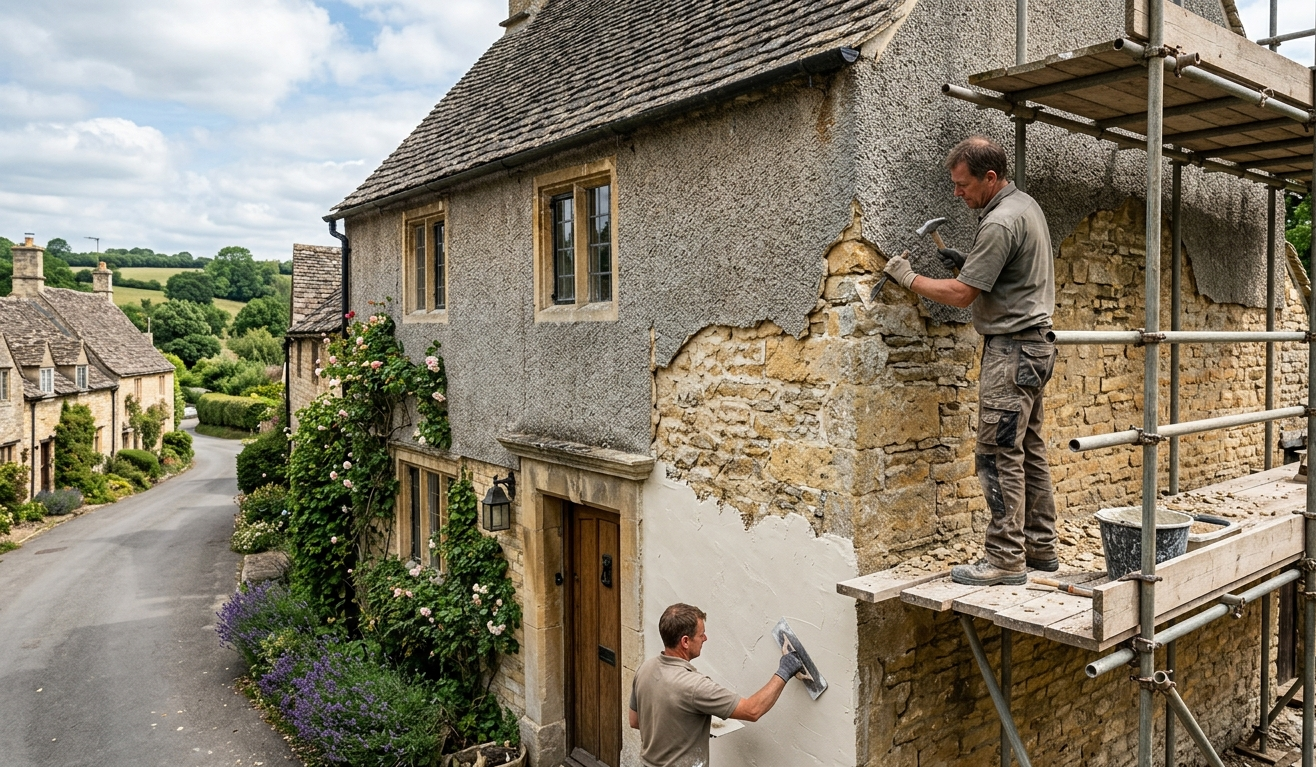
Many historic homeowners across the Cotswolds face severe damp issues caused by inappropriate twentieth-century exterior wall coverings. Property owners often struggle to find accurate, localized pricing and structural guidance for Pebbledash Removal and Lime Render Replacement.
Remedying these structural flaws requires a delicate balance of careful extraction and authentic material selection. Heritage Plastering specializes in stripping away suffocating layers to expose original stone, preparing the building fabric for long-term protection with expert lime rendering services.
A successful restoration relies on understanding how traditional buildings breathe and managing the financial commitments accurately from the start. This guide breaks down current removal expenses, lime material benefits, and hidden masonry repair costs across the region.
Pebbledash Removal and Lime Render Replacement in Gloucestershire:
Maintaining a historic building requires a firm understanding of regional material dynamics to prevent irreversible structural decay. Gloucestershire properties face high exposure to driving rain, making the breathability of exterior walls absolutely vital.
Twentieth-century cement coatings trap moisture within porous stone or brick walls, accelerating internal dampness and stone spalling during winter freeze-thaw cycles. Removing these rigid coatings allows the underlying timber frame or stone matrix to dry out naturally.
Restoration projects must be carefully categorized by the condition of the underlying masonry to establish realistic timelines and financial budgets. Minor surface spalling, extensive stone degradation, and structural timber repairs demand distinct conservation treatments.
Understanding the Dangers of Cementitious Coatings
Rigid cement blockades prevent moisture from escaping the building fabric, forcing water inward toward internal plaster and living areas. Over time, this trapped moisture breaks down historic lime mortars, turning supporting materials into loose powder.
The removal process requires patience and precision to avoid scarring the delicate limestone or period brick beneath the hard shell. Hand tools and low-pressure pneumatic chisels are carefully utilized to peel away the modern render layers.
Exposing the underlying masonry reveals the true extent of historic fabric damage caused by decades of moisture retention. Utilizing specialized assessment services helps determine whether the exposed surfaces require immediate stabilization or local rebuilding.
The Structural Advantages of Traditional Mortars
Traditional lime mixes act as sacrificial elements, drawing moisture out of the wall and allowing it to evaporate harmlessly into the air. This continuous breathing cycle keeps the internal structure dry, preventing rot in historic timber frames.
Selecting the appropriate mix depends entirely on the specific stone type, local weather exposure, and architectural style of the building. Pure hydraulic limes or traditional fat lime putties offer the flexibility needed to accommodate natural building movement.
Ensuring a flat, well-bonded base layer prevents the final topcoats from cracking or detaching under harsh weather conditions. Investing in professional modern plastering skills on secondary extensions ensures seamless transitions between new and historic wings.
Executing the Multi-Stage Application Process
Applying authentic lime coatings is a highly weather-dependent craft that cannot be rushed or executed in freezing conditions. The process requires a three-coat application system, consisting of a scratch coat, a floating coat, and a final finish coat.
Each layer must be allowed to cure slowly, often requiring damp hessian masking to shield the surface from direct sunlight and wind. This controlled drying phase prevents shrinkage cracks and ensures a durable, long-term bond with the stone.
Historic properties require careful material matching to preserve their protected status and local visual characteristics. Utilizing traditional lime plastering techniques satisfies conservation officers while providing exceptional weather defense for vulnerable stone facades.
Material Cost Allocation and Pricing Guidelines
Project pricing in the Southwest varies significantly depending on scaffolding requirements, accessibility, and the stubbornness of the existing cement bond. Homeowners should anticipate total costs ranging from £110 to £160 per square metre for full stripping and three-coat lime replacement.
Scaffolding infrastructure represents a significant fixed cost component, particularly for multi-storey townhouses or restricted rural lanes. Safety compliance and structural access must be factored into the initial budget framework before work begins.
| Restoration Component | Expected Cost Range (per sq m) | Typical Gloucestershire Timeline |
| Scaffolding Access Setup | £15 – £25 | 1 – 2 Days |
| Cement Pebbledash Removal | £35 – £55 | 3 – 5 Days |
| Masonry Repair & Re-pointing | £20 – £40 | 2 – 4 Days |
| Three-Coat Lime Render Application | £55 – £80 | 7 – 14 Days (plus curing) |
Local Conservation Regulations and Listed Buildings
A significant portion of Gloucestershire falls within protected Conservation Areas or the Cotswolds National Landscape boundaries. Altering the exterior appearance of properties within these zones frequently requires formal planning permission from local authorities.
Listed buildings require specific Listed Building Consent before any cement removal or plastering alterations take place on site. Using incorrect modern materials on a protected structure can result in legal enforcement action and compulsory reversal mandates.
Conservation officers generally insist on seeing material samples and historic color matches before approving final finishing coats. Documenting the historical precedence of the property ensures a smooth approval process with local district councils.
Hidden Structural Discoveries and Contingency Planning
Stripping away twentieth-century coatings often reveals historic structural issues that were intentionally hidden or exacerbated by the cement. Common discoveries include missing lintels, fractured stone arches, and completely decayed rubble infill zones.
Addressing these masonry failures immediately prevents structural shifting once the protective external layers are altered. Replacing damaged stone with matching local Cotswold limestone preserves the structural continuity of the load-bearing walls.
Maintaining a dedicated financial buffer prevents unexpected structural discoveries from stalling the restoration project midway through production. Specialists recommend reserving a fifteen to twenty-five percent contingency fund specifically for periodic property interventions.
Long-Term Maintenance and Coating Care
Authentic lime finishes must never be sealed with modern plastic-based masonry paints or synthetic waterproofing chemicals. Using non-breathable paints completely invalidates the performance of the lime, trapping moisture back inside the building.
Traditional limewashes or highly breathable silicate mineral paints provide vibrant color options while maintaining full vapor permeability. These specialized coatings fuse chemically with the lime base, creating a highly durable and self-cleaning exterior surface.
Annual inspections of gutters, lead flashings, and downpipes protect the new facade from concentrated water cascading down the walls. Keeping ground levels well below the internal floor line further prevents rising damp issues from developing over time.
Selecting Qualified Pebbledash Removal and Lime Render Replacement Specialists
Verifying specific experience with historic structures and lime-based materials protects property owners from substandard installations. Requesting references from completed projects within the region helps confirm a contractor understands local stone characteristics.
Detailed estimates should clearly distinguish between the removal phases, stone stabilization, and the specific type of lime specified. Transparent communication regarding weather dependencies ensures realistic expectations regarding project handovers and curing intervals.
Finalizing the Restoration Project
Restoring a period property requires a commitment to using correct historical materials and accepting natural environmental timelines. Correcting past material mistakes prevents structural deterioration and preserves the architectural heritage of the region.
Finalizing material configurations and scaffolding schedules early keeps the site moving efficiently during optimal spring and summer working windows. Avoid making rushed changes during the delicate curing stages to ensure a flawless finish.
Partnering with dedicated craftspeople ensures that your historic home remains structurally sound and visually stunning for decades to come. To discuss your property needs with a local professional, visit our Contact Us page to connect with a specialist.
Frequently Asked Questions:
How much does pebbledash removal cost per square metre in Gloucestershire?
In 2026, removing cementitious pebbledash and replacing it with a traditional three-coat lime render typically costs between £110 and £160 per square metre. Final costs depend heavily on scaffolding accessibility and underlying stone repairs.
Why is cement render dangerous for Cotswold stone properties?
Cement render is entirely non-permeable, meaning it traps moisture inside the stone walls. This trapped water cannot evaporate, leading to internal damp, timber decay, and the physical crumbling of the limestone during freezing weather.
Do I need Listed Building Consent to remove pebbledash?
Yes. If your property is a Listed Building, you must obtain Listed Building Consent from your local council before removing any render or applying new coatings. Unauthorised alterations to listed structures are illegal.
How long does the lime render replacement process take?
An average semi-detached cottage requires roughly three to four weeks on site. This timeline includes safe scaffolding erection, careful pebbledash hacking, masonry stabilization, and the application and curing of three separate lime coats.
What paint should be used over a new lime render facade?
Only high-permeability coatings like traditional limewash or modern silicate mineral paints should be used. Standard plastic-based retail masonry paints will seal the surface, destroy the breathability of the lime, and cause premature failure.