



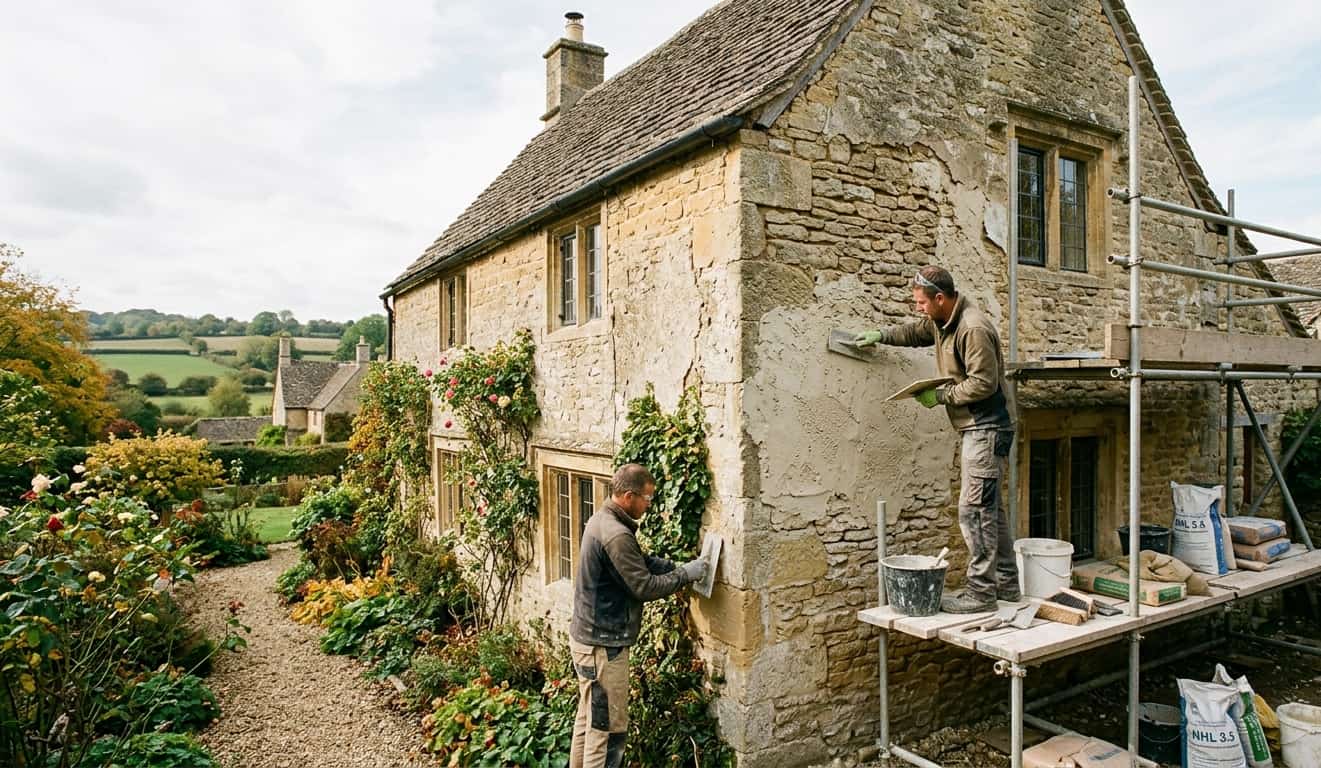
Owning a listed building in the Cotswolds is a privilege, but it comes with costs that standard homeowners do not face. When lime plaster fails, historic render needs replacing, or structural repairs become necessary to preserve a building’s character and integrity, expenses can quickly add up. Understanding grants and funding for listed building repairs in the Cotswolds can make a significant difference. While financial support is available, securing it requires knowing where to look, understanding eligibility requirements, and submitting a strong, well-supported application.
Heritage Plastering works with owners of historic and listed properties across Gloucestershire and the Cotswolds, and we see first-hand how much confusion surrounds the question of grants and financial support. This guide sets out the main sources of funding that are genuinely available and what you need to know to access them.
Grants for Listed Building Repairs in the Cotswolds: Where the Money Actually Comes From
There is no single national grant scheme that covers all listed building repairs. Funding is fragmented across different bodies, each with their own criteria, application processes, and timescales. Understanding the landscape is the first step to finding what might apply to your situation.
The main sources of funding for listed building repairs in Gloucestershire and the Cotswolds fall into four broad categories: local authority grants, Historic England funding, charitable trusts, and community or area-based funding programmes. Each operates differently and targets different types of work or property.
Cotswold District Council and Local Authority Funding
Cotswold District Council has long provided a scheme that helps fund repairs to listed buildings within its area, especially those located in conservation areas or identified as being at risk. The council does not guarantee funding, and available allocations can change each year based on budget priorities. Property owners should contact the planning department early to discuss potential funding opportunities and eligibility requirements.
Some local authorities in Gloucestershire also offer discretionary grants for urgent structural repairs to listed buildings, particularly where a building has been identified on the Historic England At Risk Register. These grants tend to cover a percentage of eligible costs rather than the full amount, and they typically require the use of appropriate materials and approved contractors.
The key is to contact your local planning authority early, before work starts. Grants are rarely available retrospectively, and starting work without approval can disqualify you from funding entirely. This is especially true for lime plastering in Cheltenham where local conservation requirements and funding criteria often overlap.
Historic England Grants: What Is Available and Who Qualifies
Historic England administers several funding streams that can support repairs to listed buildings and scheduled monuments. The most relevant for property owners in the Cotswolds are the Historic England Repair Grants for At Risk Buildings and the Heritage at Risk programme.
To be eligible, a building generally needs to be on the Historic England Heritage at Risk Register, or the work needs to demonstrate a clear benefit to the preservation of nationally significant historic fabric. The grants are competitive and the application process is detailed, requiring full condition surveys, conservation management plans, and often a track record of appropriate stewardship.
For buildings not on the at-risk register, direct funding from Historic England is less accessible. However, Historic England also supports Heritage Action Zones in certain areas, which can unlock additional funding streams for properties within designated zones.
Understanding why lime plaster is essential for listed and heritage buildings is relevant here because grant applications almost always require you to demonstrate that appropriate conservation materials will be used. An application proposing cement render on a Cotswold stone building is unlikely to succeed.
The National Lottery Heritage Fund
The National Lottery Heritage Fund is one of the larger sources of grants for heritage projects in the UK. While many of its larger grants target community or institutional heritage projects, the Fund does offer smaller grants that individual building owners can access, particularly where there is a community or public benefit element.
If your listed building has some form of public access, is connected to a community project, or forms part of a wider heritage initiative, it may be worth exploring whether a Heritage Fund application could support plastering or rendering repairs as part of a broader conservation programme.
The Fund requires thorough applications and has specific requirements around matched funding, project management, and reporting. It is not a quick route to funding, but for significant repair projects it can provide substantial support.
Charitable Trusts and Foundations Supporting Heritage Repairs
Several charitable trusts specifically support the repair and conservation of historic buildings in England, and some have a particular focus on the Cotswolds or the wider South West region.
The Pilgrim Trust has a long history of supporting conservation of historic buildings and is worth approaching for significant repair projects. The Wolfson Foundation supports heritage projects and has funded building repair work including plastering and structural conservation. The Architectural Heritage Fund can provide both grants and loans for heritage building projects, including support with project development costs.
For owners of ecclesiastical buildings or structures with historical or cultural significance, additional specialist trusts may apply. The key with charitable applications is to be specific about the work needed, why it is significant, why lime or traditional materials are the right solution, and what will happen to the building if the repairs are not carried out.
Knowing the advantages of lime render and being able to articulate them clearly in an application demonstrates to funders that you understand what is required and why it matters.
VAT Relief on Listed Building Repairs: Not a Grant but Still Worth Knowing
While not a grant, VAT relief on approved alterations to listed buildings is worth understanding because it can significantly reduce the cost of eligible work. Certain types of approved work on listed buildings qualify for the reduced 5% VAT rate or, in some cases, zero rating, rather than the standard 20%.
The rules are complex and have changed in recent years, so taking proper advice from an accountant or VAT specialist before your project begins is important. Plastering and rendering using lime materials on a listed building is often eligible for reduced VAT where the work is part of an approved alteration, but the specific requirements need to be verified for each project.
This saving alone can make a meaningful difference to the overall cost of a significant repair project, and it is something that owners of Grade II listed properties requiring plaster repair should always explore before starting work.
Area-Based Regeneration Schemes
In certain parts of Gloucestershire and the Cotswolds, area-based regeneration or conservation area schemes have made funding available for external repairs to properties within designated boundaries. These schemes typically operate for a limited period and focus on specific improvements, such as repairing render, restoring windows, or improving rooflines.
To determine whether your property qualifies for one of these schemes, contact your local council’s planning department and ask about any conservation area grant schemes or townscape heritage initiatives currently available in your area.
Making a Successful Application: Practical Tips
Applicants improve their chances of securing grant funding for listed building repairs when they submit specific, well-supported proposals and demonstrate that qualified contractors will carry out the work using appropriate traditional materials.
Start with a professional condition survey from a building surveyor experienced in historic structures. This gives you an authoritative assessment of what needs doing and why. Pair this with a material specification from a plastering contractor with demonstrable experience in lime-based work and conservation projects.
Show that you understand the significance of the building and the importance of using the right materials. Applications that treat the funding as simply a way to reduce costs on any plastering job are less likely to succeed than those that demonstrate genuine conservation intent.
Keep in mind that renovating historic properties with lime plaster is both a technical and a heritage responsibility, and framing your application around that dual purpose will resonate with most funders.
Frequently Asked Questions
Can I get a grant to replaster my listed building in the Cotswolds?
Yes, funding is available through various sources, including local authority schemes, Historic England, charitable trusts, and lottery funding. Eligibility depends on the building’s status, the type of work, and the materials proposed. Contact your local planning authority as a first step.
Does Historic England give grants to private homeowners?
Historic England provides repair grants to private owners of listed buildings, but it typically directs this funding toward buildings listed on the Heritage at Risk Register or those with exceptional historic significance. For most private owners, local authority or charitable trust routes may be more accessible.
Is VAT zero-rated on listed building repairs?
Certain approved alterations to listed buildings qualify for zero or reduced rate VAT. Repairs and maintenance do not automatically qualify. You need to check your specific project with a VAT specialist before starting work.
Do I need to use lime plaster to qualify for heritage grants?
In most cases, grant-awarding bodies and conservation officers require applicants to use appropriate traditional materials. They are unlikely to support an application for a listed Cotswold building that proposes modern gypsum or cement instead of traditional materials.
What is the Heritage at Risk Register, and how do I check if my building is on it?
The Historic England Heritage at Risk Register identifies buildings, sites, and areas that face threats from neglect, deterioration, or inappropriate development. The register helps prioritize conservation efforts and directs attention and resources toward protecting these vulnerable heritage assets. You can search the register on the Historic England website by location or building name.