



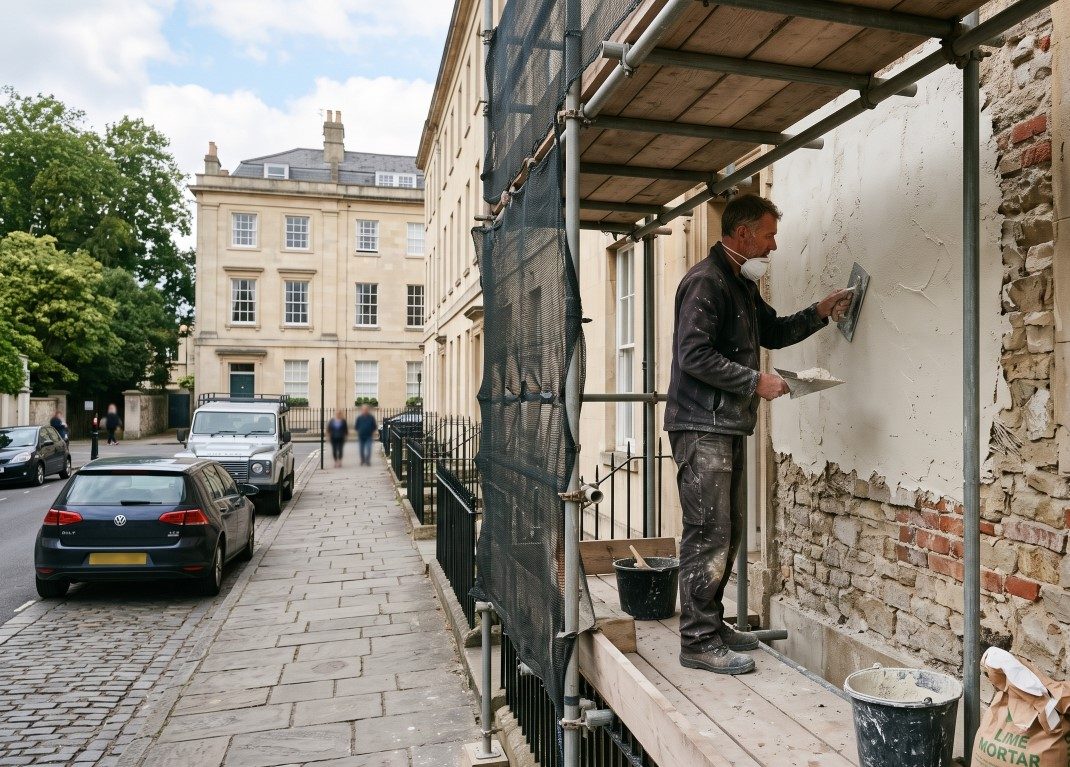
External render repair cost in Cheltenham is typically higher for listed buildings because conservation work requires traditional materials and specialist expertise. Traditional lime rendering usually costs between £90 and £150 per square metre, while modern cement or acrylic renders generally cost £35 to £75 per square metre. However, listed building regulations prohibit the use of modern synthetic render systems on many period properties. Applying non-breathable coatings can trap moisture inside historic solid walls, accelerate masonry decay, and potentially lead to enforcement action by the local planning authority. To meet conservation requirements and protect the building, external render repairs should use authentic lime putty or natural hydraulic lime mortar applied by an experienced conservation contractor, ensuring the walls remain structurally sound and breathable.
Homeowners planning exterior property maintenance must navigate both financial factors and strict municipal conservation rules. Regency terraces and historic masonry require highly specialized handling to retain their architectural character.
Heritage Plastering’s priority is delivering historically accurate facade solutions that align with local authority guidelines. Choosing the correct external finish safeguards the property value while avoiding expensive enforcement actions.
External Render Repair Cost in Cheltenham: Lime vs. Modern Render
Calculating the initial capital investment for an exterior wall renovation requires a close look at material performance and labor demands. Modern sand and cement renders set very quickly, allowing general building firms to finish jobs inside a brief window.
Traditional external render repair cost in Cheltenham reflects the multi-layered process and slow drying cycles that historic materials demand. Lime coatings require days of carbonation between coats, which naturally expands the time required on-site.
A patch repair or two-coat surface skim using natural hydraulic lime typically starts around £90 per square metre. Complete strip-outs and traditional three-coat applications on tricky timber lath backgrounds can push rates past £150 per square metre.
Modern synthetic renders appear significantly cheaper on initial builder estimates, averaging under £60 per square metre. Yet, using these cheap rigid barriers on historic timber or rubble walls creates a serious structural conflict.
Why Modern Renders Destroy Historic Exterior Facades
Applying a completely solid, impermeable coating over ancient brick or limestone disrupts the natural mechanics of the property. Traditional solid-wall structures do not possess modern cavities or damp-proof barriers to deflect wet weather.
Instead, they function by absorbing ambient moisture and releasing it back into the open atmosphere when wind conditions change. Sealing the external skin with modern plastic or cement finishes forces moisture to push inward instead.
This trapped water saturates the internal living space, ruining decorative internal finishes and causing systemic rot. Property owners must evaluate how cement render creates damp walls before allowing any general contractor to patch their external brickwork.
The building fabric begins to delaminate behind the hard cement casing over a handful of freeze-thaw winter cycles. The internal masonry turns into a soft, powder-like state, resulting in massive repair bills later on.
Evaluating Technical Binder Specifications for External Masonry
Selecting the correct grade of external material requires checking the exact structural exposure of the building. Using a mix that is too rigid will lead to hairline surface cracks and water ingress.
Using a compound that is too soft will cause the exterior render to erode prematurely from wind-driven rain. Finding the exact material balance keeps your exterior render durable for generations.
Selecting the Right Grade of Natural Hydraulic Lime
Contractors must choose a specific product class depending on whether they are working on a sheltered townhouse or an exposed country cottage. Property owners should review the technical differences regarding NHL 3.5 vs NHL 2 lime plaster to understand structural setting times.
An NHL 3.5 specification provides the ultimate durability for external elevations facing extreme weather. Softer NHL 2 mixes are generally reserved for sheltered facades or delicate internal masonry work.
The Role of Hair and Fibre Reinforcement in Base Coats
Traditional base coats must incorporate coarse animal fiber or modern poly-fibres to handle structural stress. This reinforcement holds the wet mortar together while it adapts to the slow movement of old foundations.
Omitting this internal mesh layer causes structural cracks to form across large, unbroken exterior surfaces. These openings allow rain to bypass the outer coating, rotting out structural timbers tucked behind the wall face.
Legal and Conservation Rules for Facade Alterations
Every external wall change on a protected property in Gloucestershire falls under strict planning control. Modifying the exterior color, texture, or thickness of an architectural facade requires explicit municipal authorization.
Applying for formal Listed Building Consent requires submitting full technical details and sand samples to the council. Proceeding with modern alternatives without this documentation can trigger criminal prosecution.
Understanding the deep legal framework of listed property plaster repair keeps your build running smoothly without unexpected stoppages. Local planning teams have the power to halt unapproved operations instantly.
The council can force homeowners to remove modern renders using manual hand tools at their own expense. This extraction work frequently causes irreversible damage to the underlying historic brickwork.
Hidden Factors That Increase External Render Costs
An accurate external quotation must account for several initial site preparation steps before any new materials can be applied. Heritage restorations involve significant background preparation that standard new builds do not require.
Removing previous layers of modern plastic paint or decaying cement render takes incredible precision. Using heavy mechanical tools can smash fragile historic brickwork, meaning slower manual work is required instead.
- Erecting secure street scaffolding with full debris netting to satisfy local council highway safety rules.
- Carefully raking out failed mortar joints by hand to a depth of twice the joint width to create a strong mechanical bond.
- Sourcing specialized local sands to replicate the historic regional color and texture of the original plaster.
- Protecting fresh wet render faces from sudden frost or direct summer sun using damp hessian sheets.
Long-Term Economics of Choosing Traditional Materials
While the initial external render repair cost in Cheltenham: lime vs. modern render favors modern choices, the long-term outlook is very different. Synthetic coatings often fail within fifteen years as trapped water breaks the adhesive bond.
Traditional lime finishes stay flexible and move along with the seasonal shifting of old timber structures. This prevents the large structural cracks that cause modern renders to fall away in large chunks.
Property owners can study a complete lime plaster guide to learn how to keep their exterior finishes performing beautifully. Using authentic products ensures your property stays dry and healthy.
Maintaining a breathable exterior protects the underlying building fabric, keeping the property structurally sound for decades. This approach preserves the real estate value of your historic home.
Frequently Asked Questions About External Render Costs
Can you spray clean a traditional lime render surface using high pressure?
Using high-pressure power washers on traditional lime rendering can cause major structural surface damage. The intense water force scores the soft surface layer, opening up deep tracks for winter frost to expand and crack the render.
Why do planning officers reject modern acrylic or K-Rend on historic cottages?
Modern acrylic or silicone-based renders create an airtight seal over the exterior walls. Planning officers reject these products because they trap water inside solid stone walls, accelerating masonry decay and causing damp issues.
Are there preservation grants available for external render repairs in Gloucestershire?
Financial assistance is sometimes available for major external restoration projects on highly significant historical assets. Homeowners can check if their build qualifies by researching grants for listed building repairs through local council conservation channels.
How often does an exterior traditional lime finish require repainting?
A professionally applied exterior lime render finished with authentic breathable mineral paint should last up to fifteen years before requiring a refresh. Standard modern vinyl paints should never be used, as they seal the wall pores.
Securing a Legally Safe and Structurally Sound Facade
Balancing repair costs against local heritage rules requires an understanding of how traditional solid walls behave. Choosing cheap modern cement options traps moisture, accelerates masonry decay, and leads to costly planning enforcement actions. Investing in authentic, breathable lime finishes protects the look, structural safety, and legality of your historic home.
Reviewing a comprehensive lime plaster guide helps clarify exactly what materials your period property requires before you collect contractor estimates. Partnering with a dedicated specialist keeps your project running smoothly. Contact our specialist heritage conservation team today to arrange an on-site survey and secure a detailed quote for your home.